

New design Vintage Mac's VGA adapter, MacVGA-Lite
Updated: Apr 11

When you look at the VGA adapters available for vintage Macintosh computers, you’ll notice that most of them are packed with DIP switches. Back in the CRT monitor era, this made sense... those switches allowed for maximum compatibility across a wide range of displays. But lose the manual, and it quickly becomes impossible to tell which switch does what.
Today, almost everyone uses LCD displays. That made me wonder why not simplify this overly complicated, now somewhat nonsensical adapter design?
That idea became the starting point for MacVGA-Lite. When I shared this concept with Bruce Rayne of Branchus Creations, he mentioned he had been thinking along similar lines himself.
Our adapter uses just a single switch. With one simple slide switch, you can set it to either mode and be confident that you’ll get a display. No more guesswork, no more frustration... just a straightforward, reliable companion.
Original Concept
My initial idea was to offer two modes: a standard VGA mode and a legacy VGA mode (based on older universal designs). The legacy mode is suitable for older Macintosh systems such as the LC series, while the VGA mode supports MultiScan displays.
Bruce suggested an alternative: instead of standard VGA mode, why not implement a 21" MultiScan mode? At first, I felt that achieving this with a single DPDT switch might be pushing the limits—but I decided to give it a try.
Prototyping
I began by building test cables based on various wiring diagrams to confirm functionality. As I experimented with different switching configurations, I referred back to cables I had designed in the past.
Without going too deep into technical details, the key idea is this, the adapter changes both the monitor ID and the sync configuration using a single switch. Normally, this would require a 3PDT switch, but with some creative design, I was able to reduce it to just one.

The first prototype worked perfectly in terms of display output.
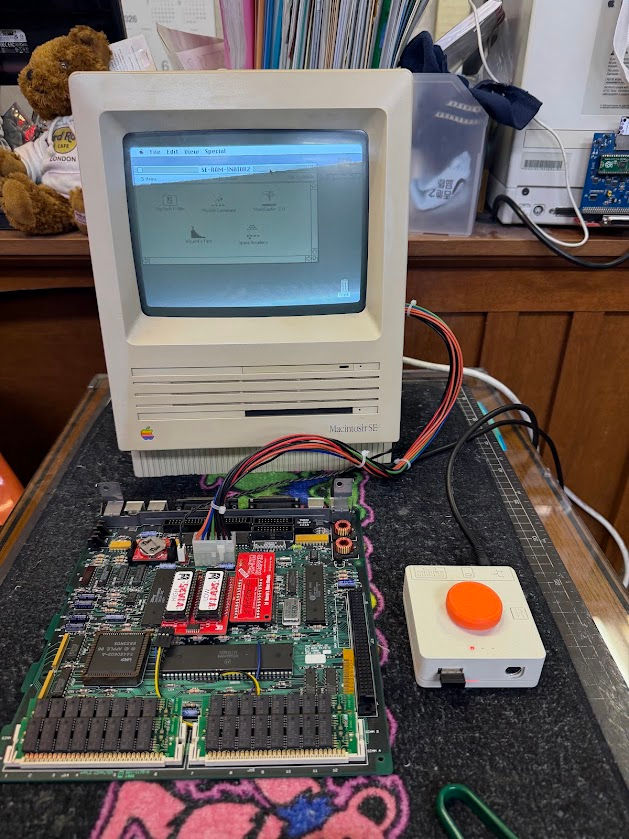
However, there was a physical issue(!) the connector pins interfered with the edge of the NuBus slot found in Macintosh II series machines...


To resolve this, I redesigned the Mac-side connector with a different form factor. This new design is more versatile and should work with virtually any desktop Macintosh.
Final Design

When the new PCB arrived, I finally had the chance to test the refined version... and the results were excellent.


The clearance between the adapter and the NuBus slot edge is now perfect, with plenty of room.
Modes

Universal 640×480 Mode
This mode ensures display output on most older Macintosh models, such as the LC and LC II. The display area is fixed at 640 x 480.

MultiScan Mode
Based on Apple’s official specifications, this is a 21-inch multiscan mode supporting resolutions from 640×480 up to 1152×870. It is compatible with later models, including Power Macintosh systems.


*This adapter is designed primarily for LCD displays. While many CRT monitors will also work, compatibility may vary depending on the model.
With just these two modes, the vast majority of Macintosh computers can output to an LCD display. There’s no longer any need to dig through manuals or struggle with complex scan mode settings. As mentioned earlier, simply set the switch to either position, and you’ll get a display. Some Macintosh models will even work in both modes.

We want to offer this adapter at the lowest possible price. Spending a fortune on just a display adapter is foolish. The first batch will be offered at a special launch price, and the kit will likely sell for $8 USD.
You can purchase it from the product page linked below.

Simple, reliable, and designed to make your Vintage Mac hobby time more comfortable, the MacVGA-Lite is a dependable companion.
Comments