

Macintosh Models That Can Natively Boot System Software 6.0.8, 7.1, and 7.5.3
For beginners and those returning to the Mac system after decades away.
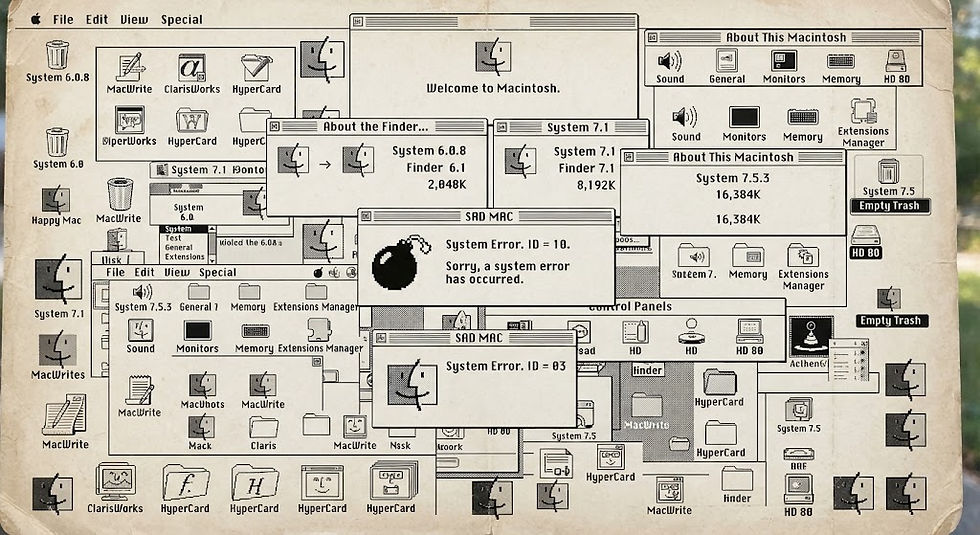
Some generations of Macintosh System Software require a System Enabler specifically designed for a particular Macintosh model.
This article focuses on three particularly important and mature releases of Apple's general-purpose Macintosh System Software:
System Software 6.0.8
System 7.1
System 7.5.3
The purpose is to identify which Macintosh models can boot these versions without adding a model-specific System Enabler.
PowerBook models are excluded from this comparison.
What Does "Native Boot" Mean?
In this article, native boot means that a Macintosh can boot using the standard System Folder from the corresponding general-purpose System Software, without adding a model-specific System Enabler.
There is an important qualification, however.
A Macintosh may not require a System Enabler but may still require additional software for hardware-specific reasons. For example, some machines require 32-bit addressing support such as MODE32.
This is particularly important for the SE/30, Macintosh II, Macintosh IIx, and Macintosh IIcx.
In other words:
"No System Enabler required" does not necessarily mean "no additional software required."
This distinction is easy to overlook when working with vintage Macintosh systems today.
If you have not used a 68K Macintosh in decades and are bringing an old machine back to life with something like BlueSCSI, this information should help when choosing an appropriate System Software version.
System Software 6.0.8

System Software 6.0.8 is an important release that covers a wide range of early 68K Macintosh computers, from the Macintosh Plus and SE through machines such as the Macintosh IIfx and the original LC.
Based on Apple's Technical Information Library documentation, the following Macintosh models are supported:
Macintosh | System Software 6.0.8 |
Macintosh Plus | Native boot |
Macintosh SE | Native boot |
Macintosh SE/30 | Native boot |
Macintosh II | Native boot |
Macintosh IIx | Native boot |
Macintosh IIcx | Native boot |
Macintosh IIci | Native boot |
Macintosh IIfx | Native boot |
Macintosh IIsi | Native boot |
Macintosh LC | Native boot |
Macintosh LC II | Native boot |
Macintosh Classic | Native boot |
Macintosh Portable | Native boot |
The Macintosh Classic II
The Macintosh Classic II is an important exception.
It does not use the standard System Software 6.0.8. Instead, it uses a dedicated release known as System 6.0.8L.
For that reason, the Classic II should not be listed as a standard System Software 6.0.8 machine.
System 7.1

With System 7.1, the range of supported Macintosh models expanded considerably.
At the same time, however, many newer Macintosh models began to require model-specific System Enablers.
This creates an easy source of confusion.
A Macintosh may have originally shipped with System 7.1 on a floppy disk or hard disk containing a System Enabler. A user might therefore remember that the machine "booted System 7.1" and assume that a generic System 7.1 installation would work in exactly the same way.
That is not necessarily the case.
For example, I once tried to boot a commercially distributed, general-purpose System 7.1 installation on a Color Classic that I had previously used with System 7.1. The system stopped with an alert rather than booting.
This is why the following table does not simply list Macintosh models supported by System 7.1.
It lists only the models that can boot System 7.1 without adding a model-specific System Enabler.
Macintosh | System 7.1 |
Macintosh Plus | Native boot |
Macintosh SE | Native boot |
Macintosh SE/30 | Native boot |
Macintosh Classic | Native boot |
Macintosh Classic II | Native boot |
Macintosh II | Native boot |
Macintosh IIx | Native boot |
Macintosh IIcx | Native boot |
Macintosh IIci | Native boot |
Macintosh IIfx | Native boot |
Macintosh IIsi | Native boot |
Macintosh LC | Native boot |
Macintosh LC II | Native boot |
Macintosh Portable | Native boot |
Quadra 700 | Native boot |
Quadra 900 | Native boot |
Quadra 950 | Native boot |
The Quadra Series
It is important to remember that not all Quadra models behave the same way.
The Quadra 700, Quadra 900, and Quadra 950 can boot System 7.1 without a System Enabler.
Other models, including the Quadra 605, 610, 650, 660AV, 800, and 840AV, require model-specific System Enablers with System 7.1.
This is a good example of why simply asking whether a Macintosh "supports System 7.1" is not enough.
System 7.5.3

With System 7.5.3, the range of Macintosh models becomes much larger.
Using Apple's compatibility information and focusing specifically on machines that do not require a System Enabler, the following models can natively boot System 7.5.3.
Macintosh Series
Macintosh | System 7.5.3 |
Macintosh Plus | Native boot |
Macintosh SE | Native boot |
Macintosh SE/30 | Conditional |
Macintosh Classic | Native boot |
Macintosh Classic II | Native boot |
Macintosh Color Classic | Native boot |
Macintosh II | Conditional |
Macintosh IIx | Conditional |
Macintosh IIcx | Conditional |
Macintosh IIci | Native boot |
Macintosh IIfx | Native boot |
Macintosh IIsi | Native boot |
Macintosh IIvi | Native boot |
Macintosh IIvx | Native boot |
LC Series
Macintosh | System 7.5.3 |
Macintosh LC | Native boot |
Macintosh LC II | Native boot |
Macintosh LC III | Native boot |
Macintosh LC 475 | Native boot |
Macintosh LC 520 | Native boot |
Macintosh LC 550 | Native boot |
Macintosh LC 575 | Native boot |
Macintosh LC 580 | Native boot |
Macintosh LC 630 | Native boot |
Macintosh TV | Native boot |
Centris Series
Macintosh | System 7.5.3 |
Centris 610 | Native boot |
Centris 650 | Native boot |
Centris 660AV | Native boot |
Quadra Series
Macintosh | System 7.5.3 |
Quadra 605 | Native boot |
Quadra 610 | Native boot |
Quadra 630 | Native boot |
Quadra 650 | Native boot |
Quadra 660AV | Native boot |
Quadra 700 | Native boot |
Quadra 800 | Native boot |
Quadra 840AV | Native boot |
Quadra 900 | Native boot |
Quadra 950 | Native boot |
Performa Series
System 7.5.3 also greatly expanded compatibility across the Performa family.
Representative models that can natively boot System 7.5.3 include:
Performa | System 7.5.3 |
Performa 450 | Native boot |
Performa 460 series | Native boot |
Performa 475 series | Native boot |
Performa 550 series | Native boot |
Performa 575 series | Native boot |
Performa 600 | Native boot |
Performa 6110 series | Native boot |
Performa 630 series | Native boot |
Performa 5200 series | Native boot |
Performa 5300 series | Native boot |
Performa 6200 series | Native boot |
Performa 6300 series | Native boot |
Power Macintosh Series
System 7.5.3 was also widely used on the first generation of Power Macintosh computers.
Many early Power Macintosh models can boot System 7.5.3 without a System Enabler.
Macintosh | System 7.5.3 |
Power Macintosh 5200 series | Native boot |
Power Macintosh 5260 | Native boot |
Power Macintosh 5300 series | Native boot |
Power Macintosh 6100 series | Native boot |
Power Macintosh 6200 | Native boot |
Power Macintosh 6300 | Native boot |
Power Macintosh 7100 series | Native boot |
Power Macintosh 7200 series | Native boot |
Power Macintosh 7500 | Native boot |
Power Macintosh 7600 | Native boot |
Power Macintosh 8100 series | Native boot |
Power Macintosh 8500/120 | Native boot |
Power Macintosh 9500 series | Native boot |
However, not every Power Macintosh can boot a generic System 7.5.3 installation.
For example, models such as the Power Macintosh 4400/200, 5400, 6400, and 6500 may require a model-specific System Enabler even though System 7.5.3 itself supports them.
Again, this demonstrates the important distinction between:
A Macintosh being supported by System 7.5.3
and
A Macintosh being able to boot a generic System 7.5.3 System Folder without a System Enabler.
What We Can See by Comparing These Three System Generations
Comparing System Software 6.0.8, 7.1, and 7.5.3 shows how dramatically Macintosh compatibility evolved over time.
Macintosh generation | 6.0.8 | 7.1 | 7.5.3 |
Macintosh Plus | ✓ | ✓ | ✓ |
Macintosh SE | ✓ | ✓ | ✓ |
Macintosh SE/30 | ✓ | ✓ | Conditional |
Macintosh II | ✓ | ✓ | Conditional |
Macintosh IIx | ✓ | ✓ | Conditional |
Macintosh IIcx | ✓ | ✓ | Conditional |
Macintosh IIci | ✓ | ✓ | ✓ |
Macintosh IIfx | ✓ | ✓ | ✓ |
Macintosh IIsi | ✓ | ✓ | ✓ |
Macintosh LC | ✓ | ✓ | ✓ |
Macintosh LC II | ✓ | ✓ | ✓ |
Macintosh Classic | ✓ | ✓ | ✓ |
Macintosh Classic II | 6.0.8L | ✓ | ✓ |
Quadra 700 | N/A | ✓ | ✓ |
Quadra 900 | N/A | ✓ | ✓ |
Quadra 950 | N/A | ✓ | ✓ |
LC III | N/A | Enabler required | ✓ |
LC 475 | N/A | Enabler required | ✓ |
LC 575 | N/A | Enabler required | ✓ |
Quadra 605 | N/A | Enabler required | ✓ |
Quadra 800 | N/A | Enabler required | ✓ |
Color Classic | N/A | Enabler required | ✓ |
Why I Would Avoid System 7.5.3 on 4 MB 68000 Macs
There is an important practical issue that a simple compatibility table does not show.
Although the Macintosh Plus, Macintosh SE, and Macintosh Classic can technically boot System 7.5.3, I would generally avoid using System 7.5.3 on these machines when they are limited to their maximum 4 MB of RAM.
The reason is not simply whether the operating system can boot.
System 7.5.3 consumes substantially more memory than earlier System Software releases. Its multitasking environment also adds to the overall memory burden.
As a result, significantly less memory remains available for applications.
This can cause:
Reduced application memory
Slower overall performance
Insufficient memory for Extensions and Control Panels
Extensions failing to load
"Not enough memory" alerts
Increasingly sluggish Finder performance
Virtual Memory can technically compensate for some of the memory shortage, but on a 4 MB Macintosh, enabling Virtual Memory can make the system extremely slow.
The Macintosh may still boot, but the resulting experience can be far from practical.
So there is an important distinction between:
"It boots."
and
"It is a sensible configuration."
For a 4 MB Macintosh Plus, SE, or Classic, an earlier System such as System 6 or System 7.1 is generally a much more practical choice.
An Important Note About the SE/30
The SE/30 deserves special attention.
According to Apple's compatibility information, the SE/30 is supported by System 7.5.3 and does not require a System Enabler.
However, the standard SE/30 ROM has a limitation concerning 32-bit addressing.
Therefore, using System 7.5.3 on an SE/30 requires a mechanism to enable 32-bit addressing in addition to the System Software itself.
The best-known solution is MODE32.
Therefore, in the strictest sense, an SE/30 running System 7.5.3 is not a completely "nothing else required" configuration.
The same issue applies to the Macintosh II, IIx, and IIcx.
This is an important detail that can easily be missed when looking only at System Enabler compatibility.
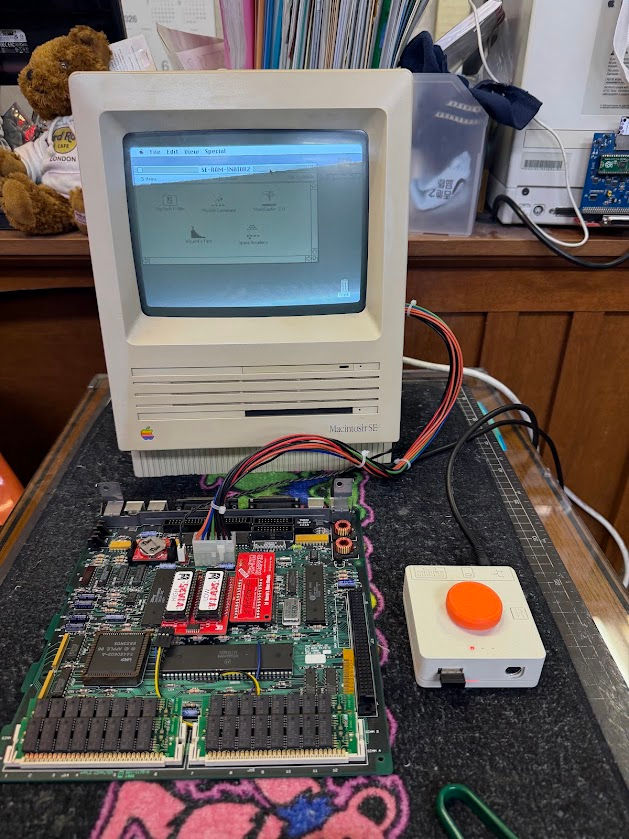
For more information about the SE/30 installation issue, Steve Chamberlin of Big Mess o' Wires has documented the subject in detail. A similar approach can also be implemented using the SMC ROM SIMM.
Conclusion
Comparing System Software 6.0.8, 7.1, and 7.5.3 provides an interesting look at how Apple's Macintosh System Software evolved.
System Software 6.0.8 primarily served the earlier generation of 68K Macintosh computers, covering machines such as the Macintosh Plus, SE, Macintosh II, and early LC models.
With System 7.1, compatibility expanded to newer machines such as the Quadra 700, 900, and 950. At the same time, however, an increasing number of newer Macintosh models began to depend on model-specific System Enablers.
By System 7.5.3, a single general-purpose System Software release could cover a remarkably broad range of 68K Macintosh computers as well as many early Power Macintosh models.
Yet even then, some newer Macintosh models still required System Enablers.
The key point is therefore:
A Macintosh being supported by a particular System Software release does not necessarily mean that it can boot using a generic System Folder alone.
When researching Macintosh System Software compatibility, it is important to distinguish between two different questions:
Is this Macintosh supported by this version of System Software?
Can this Macintosh boot the generic System Folder without a System Enabler?
These are not necessarily the same thing.
This distinction becomes particularly important when creating disk images for vintage Macs today. Whether you are restoring an original hard drive, preparing a SCSI2SD image, or setting up a BlueSCSI disk image, knowing exactly what the original Macintosh requires can save a great deal of trial and error.
And sometimes, the most important question is not "Will it boot?"
It is simply:
"Should I really be running this version of System Software on this Macintosh?"

Comments